Monday, September 24, 2018

Musician's Yoga, Body Mapping, and the Alexander Technique: Awareness

Let's jump right in, shall we.  Physically, I struggle to "work out" because as a young person, I was constantly engaged in physical activity such as ballet and other dance forms, soccer, tennis, gymnastics, etc.  I never had to "work out".  Now that I am older, and I am not getting any younger (no body is, get it?), I feel my body ache doing things I was once able to do without a second thought.  Mentally, in short, I have responsibilities (kids will do that) that I have not had before.  I often find myself stressed.  So this summer, I decided to do some reading that would, hopefully, make me more knowledgeable about my overall well-being, both physical and mental. My reading included the following books: Musician's Yoga: A Gude to Practice, Performance, and Inspiration by Mia Olson; Body Mapping for Flutists: What Every Flute Teacher Needs to Know About the Body by Lea Pearson; and Simple Step-by-Step Alexander Technique by Michèle Macdonnell.

After reading these books, I by no means am an expert on these topics, however I do feel enlightened and inspired to learn more and improve myself. The first two books are written by flutists, which is awesome because, hey, I am a flutist.  Here is what all of the books seem to agree on, emphatically: 1) awareness of your body and its responses to everyday activity is extremely important and 2) we carry stress around in our body through misuse and tension both of which can inhibit our ability to perform mundane tasks and/or perform musically.  All three also provide many pictures which demonstrate proper balance and poise and conversely imbalance in the structure of the body.

Musician's Yoga offers meditations and yoga routines, as well as individual poses, to help a flutist find inner calm and balance.  The varying routines, each including multiple poses, to focus the energy of the body, increase flexibility, and implement the balance found in all aspects of flute playing (from practice to performance) will help you become more aware of your posture as you play.


Body Mapping goes into great detail about how each part of the body works and how the whole structure is connected.  What I got out of it, based on the aches I have felt of late, is that the tension in my neck is hindering my ability to breathe fully/quietly/effectively, to feel flexible and relaxed in my playing stance, tongue faster, and even use the maximum mobility of my fingers.  It seems crazy yet also so obvious that tension in one area of my body spreads throughout and impacts my playing.


Finally, Alexander Technique,  offers a brief but clear introduction to the technique which focuses on the primary control (the alignment and relationship between the head, neck, and back).  It suggests that we study the way babies/toddlers move, their stature, to realize what natural poise looks like.  It is often suggested, by the way, to watch babies breathe to understand the proper/natural/most efficient breathing technique.


Again, I am not an expert, but rather an intrigued student who has only just begun this journey.  I plan to slowly teach myself how to implement the finer points of all of these books into my everyday life and, of course, into my playing.  In the last few weeks I have started to do yoga, via DVD.  I can already feel a difference in the way I carry myself and stand.  I feel less tension while I play.  However, I am far from mastering yoga and I can only imagine how much better I will feel as I continue to practice yoga.  In the near future, I would love to make up my own routines, with guidance from Olson's book and other experts, that I can use daily for myself or teach my studio students.  These routines could be an overall experience or singularly focused to release tension and improve flexibility in a particular area of the body.  It is my hope that as I learn my own body map, I can help my students learn and correct, as needed, their own.  Furthermore, taking note of how I complete everyday tasks will only prolong my body's ability to perform music without falling prey to tendinitis or other painful aches.  It starts with how I stand, how I sit, how I bend over to pick something up, how I write on my computer or on a piece of paper at a desk; all of these positions we put our bodies in and forget to consider, to be aware of, how our body feels.  Awareness is paramount.  As discussed in both Olson's and Pearson's book, inclusive awareness, taking in all around you, is part of the musical experience.  Macdonnell discusses this type of awareness too when she talks about being in the present, in the now.

It is so easy to get lost in the music, to only see the music.  Yet, if we are not mentally and physically healthy and aware, then it is all for naught.

Monday, September 10, 2018

Let's Talk About the Alabama All-State Band Flute Audition Etudes

Welcome to my studio!  Here are my videos on how to practice, think, and prepare the etudes for the Alabama All State Band Auditions for 2019 (auditions music/requirements).  For anyone considering auditioning for all-state, let me first say that I think that is great!  It is a good short term goal that, as proper motivation, will allow you the opportunity to grow as a musician regardless of the audition outcome.  Practicing scales regularly leads to higher technical ability and also strengthens your theoretical understanding of music.  A good etude will push and engage you as a musician.  Remember that all music should be played musically, even scales.  An etude may be labeled as a technical etude, but it should still be played expressively.  Just some food for thought.

In my videos, I will suggest ways to practice these specific etudes.  You may have other ideas or know methods that work for you, but I wanted to share my strategies too.  Something I don't say in my videos that I would like to share now is that the technical exercise (as I call it) is one of the best, if not the best, ways to learn notes in relation to fingerings/muscle memory.  The technical exercise means playing a passage (never the whole piece, maybe 8 measures at a time or less as needed) in varied rhythms.  Straight eighths or sixteenths can be practiced in dotted rhythms, triplets, eighth and two sixteenths, etc. You can practice your scales this way too.

So, without further ado, here are the videos!  I sincerely hope that you find them helpful and that they inspire you in your practice sessions.  Good luck, happy practicing, excelsior!

Middle School Technical Etude
Middle School Lyrical Etude

High School Technical Etude

High School Lyrical Etude

Monday, September 3, 2018

Etude of the Week

In the last year, I joined a Facebook group called Etude of the Week.  Initially, I just listened to everyone as they finished up an etude book (I joined mid-book).  I enjoyed seeing flutists of all levels participating and offering each other support.  Flutists as young as 11 played at their own tempo, working on the aspects of flute playing relevant to their own personal growth.  College students shared their recordings too.  Professional flutists including Amy Porter and Nicole Esposito also posted their renditions and included tips on how to practice or what to focus on.  What an amazing opportunity presented by social media.  I should give credit where it is due, the group was created by a flutist from Flutistry Boston, Katy Wherry.


At this point, I have already participated in a full round (Köhler's Romantic Etudes) and am in the midst of another (featuring Moyse's Melodic Studies and Paganini's 24 Caprices).  This group gives me accountability.  I practice nearly every day and have personal goals, but having to record myself and post it makes it harder for me to neglect my potential to grow as a musician.  Think about it, I am out of school and don't have a professor/teacher to check in with once a week.  This is how I make up for it.  An added bonus is that my sight-reading skills are vastly improving as I only have a week, sometimes less, to learn an etude.  I am learning new music I might not have had reason to explore prior to this experience.  I have an amazing support system via the other flutists in the group; furthermore, each recording gives me a new perspective or interpretation of an etude with which I am now familiar.  There are so many positives to being in this group.

That said, I will be the first to say that I am not an overly big fan of social media.  I participate in it, but I also see that it can create, and has created, a negative environment.  I have watched videos on YouTube and read nasty comments.  When a musician is trying to improve, recording themselves and receiving feedback is key.  But the goal as compassionate human beings should be to provide constructive and supportive feedback.  No one is perfect and there is always something to improve.  But only pointing out the negatives, or just being plain mean, benefits no one and it could do serious damage to a person's self-confidence.

The nice thing about Etude of the Week is that when people comment, as far as I have seen, it is always positive.  They offer praise, words of encouragement, and constructively suggest ways to improve. It is a healthy learning environment.  I am proud to be a member of this group.  In addition to learning my etudes, it is now my goal to contribute positively to the learning environment I admire.

If you had not heard of this group before, you should absolutely check it out! Consider joining - you can be an observer until you are ready to join the fun yourself.  There you go, that is my plug for an inspiring group.  Hope to hear you playing etudes alongside me soon!

Monday, August 27, 2018

My Journey into Beatboxing


While earning my first master’s degree I met a truly inspiring flutist.  This student helped me to loosen up, chill out (if you will), in rehearsals and as a musician.  This same student introduced me to a whole new world of flute playing.  He shook up the whole studio by learning Greg Pattillo’s Three Beats for Beatbox Flute.  It was so cool!  And secretly, I wanted to be able to beatbox too.  But as with all new things, I was extremely hesitant to even try.  For years, I pushed it away, making excuses for why I couldn’t learn how to do it.  Did you catch that?  Couldn’t.  I thought I did not possess the ability to learn what my friend had.  Why?  Well, it is despairingly simple.  I was scared.  There was nothing to stop me from learning.  I could have asked my friend to give me pointers, but I didn’t.  I wasted a perfectly good opportunity.  Furthermore, I wasted five years of growth potential on fear.  I was so scared of failure and embarrassment.   There are so many quotes I can throw in here about how people who are successful weren’t afraid to fail because it would lead to success or how the only difference between successful people and unsuccessful people is the willingness to prepare, to put in the hard work.  But I don’t need to, because undoubtably you have heard them all before. 

And here’s the thing, once I decided that I was going to do it, that I was going to learn how to beatbox, I took off.  I watched countless instructional videos about how to beatbox (I will share some of my favorites at the bottom of this post), and they helped a little bit.  But at the end of the day, I learn by experience.  I started incorporating beatboxing syllables into my warm-ups, for example scales, and I purchased beatboxing etude books and pieces.  Now I know what you are thinking – there are beatboxing etudes?!  Yes, yes there are.  I will share the books I purchased with you in the following paragraphs as I compare them and detail what worked for me.  Let me say this, I don’t think I am as good of a beatboxer as my friend who so inspired me, but I do hope to have the opportunity to jam with him in the future.  I was so honored and, yes, inspired (theme of the post much?) watching my friend grow as a flutist and I can only hope that if he heard me beatboxing he would be proud of me. 

Shall we get down to it?  The book that helped me, hands down, the most in learning beatboxing was  Flute Beatboxing: Studies& Pieces by Tilmann Dehnhard.  Dehnhard has another amazing extended technique book that I may have to do an entire entry on in the future called The New Flute: Workbook & DVD.  In his beatboxing book, Dehnhard explains how to make each sound and then goes on to give focused etudes on each individual sound in progressively more challenging levels.  Level 1 is Bronze followed by Silver, Gold, and Platinum.  In the first three levels, the Ts, K, and B sound are taught on their own.  Then, in the Platinum level, the final etude is a mix of K and B.  Furthermore, there are concert studies which integrate all three sounds. Finally, he gives students “Beatbox Classics” which are familiar tunes with added beatbox sounds.  I should note that Dehnhard notates the B (bass drum) sound as P in his music and Ts as T.  You will see in this blog that composers notate beatboxing differently.  Isolating each sound and placing them in a more traditional learning setting solidified my ability to process and master each sound.  Technology is great and I loved listening to Pattillo demonstrate each sound, but this book gave me a physical goal.  I guess I am truly old school. 


I had also previously purchased The Art of Beatboxing by Brandy Hudelson which is also an etude book.  I bought it because I was working on her piece Wild Nightingale.  Wild Nightingale was my first goal in beatboxing.  I was staying clear of Three Beats, again due to fear, and wanted a piece that I could perform.  For the record, I have since worked on, although not performed, Three Beats.  Hudelson’s book was not accessible to me when I was in the beginning stages of learning to beatbox.  She introduces a lot of beatboxing syllables, each with a detailed description on how to produce the sound, and incorporates them with complex rhythms and sometimes compounds them with other extended techniques.  Having worked through Dehnhard’s book and worked on/performed Wild Nightingale, I think this book is more accessible to me now.  I would not recommend this book to learn the basics.  What this book does do that is fantastic is in the chapters leading up to the etudes, Hudelson discusses how to improvise with beatboxing and how to compose with the technique.  I arrange music for my students and for flute ensemble often and I think it would be fun to incorporate beatboxing into a future project. Below the sample notation is a recording of my dress rehearsal for a performance of Wild Nightingale (consider it proof that an old dog can learn new tricks).


The final etude book that I had purchased early on was Four Etudes for Beatbox Flute by Greg Pattillo.  This book was also a bit much for me, personally, in the beginning.  I felt like I was just thrown into the deep end.  To be fair, remember that Pattillo has multiple videos and a summer camp in which you can learn to beatbox from the pro himself.  For me, the videos didn’t engage me the way I need in order to learn.  Physical etudes hold me accountable.  Pattillo, like every composer I have encountered who uses beatboxing, provides instructions in the book on how to produce the sound.  You will see, again, that Pattillo notates differently than the previous two composers.  What is neat about this book is that the tunes are not only familiar to a musician, but also to those who do not study music.  The tunes are from popular culture and are transcriptions of some of Pattillo’s popular videos.  Again, I think I would be more successful with this book now than I was a year ago when I started this venture.

In a future post, I plan to discuss a super neat flute composer whose compositions I have been obsessed with of late: Nicole Chamberlain.  Chamberlain is a composer who has given the flute literature world a plethora of cool pieces for solo flute, duets, trios, flute choir, and mixed chamber ensembles incorporating beatboxing and other techniques.  No surprise here, Chamberlain notates the beatboxing technique differently from the aforementioned flutist-composers.   For now, I will leave you with a couple of the instructional beatboxing YouTube videos:


Saturday, August 25, 2018

Extended Techniques: The New Flute

In my previous post concerning beatboxing, I mentioned The New Flute by Tilmann Dehnhard. I would like to expand on that a bit, in the form of an entire post.  In short, I would say that this book is extremely similar in content (extended techniques) to Robert Dick's The Other Flute; however, I find this book more visually appealing and, overall, more accessible.

Dehnhard not only explains, verbally and in great detail, how to achieve and work on a given technique, he also provides a variety of exercises which begin at a beginner's level and get progressively more difficult.  I personally love having topics broken down into focused, smaller bites.  Makes it easier to swallow.  The topics discussed in this book include, but are not limited to: sing-play, beatboxing, whistle tones, wind noises (i.e. jet whistle), percussive sounds (i.e. percussive articulations), pitch bends, harmonics, multiphonics, circular breathing, tremolos, and flutter tongue.  The book also comes with an instructional DVD.

A particularly cool feature of this book is that Dehnhard combines multiple exercises into a comprehensive etude (of sorts).  While learning to sing-play, he writes an exercise in which you play the melody of a J.S. Bach Bourrée and sing an accompaniment line.

Later, while mastering beatboxing, an exercise using the melody of the Bourrée returns and beatbox syllables have been added to the fray (no singing in this instance).

Finally, a few pages later, the Bourrée is presented as an etude in which you play the melody, beatbox, and sing an accompaniment line.


How cool is that?

For me, this gives me proof of progress.  Not only did I work on mastering specific techniques, I learned a piece in fragments before seeing it all together.  No doubt, if you flip open to the final product, it is more than intimidating.  Yet, having walked through it all on your own terms, at your own pace, putting it all together seems more manageable. This process of chunking music is an important skill to learn and apply in all of your practice sessions; this book sets a good example for how to execute the chunking process.

I am slowly working through this book and will try to do regular updates on how it is going.  My plan is to learn an exercise from the book, record myself, and post the video with a brief discussion on struggles I had and/or how the book helped me improve.  So keep an eye out for that post.  Maybe I will even post the Bourrée in the future.  Just seems like a cool trick to have up your sleeve anyway.  :)  Excelsior!

Monday, August 20, 2018

"Wake up!" I'm back.


Returning to a project is always an interesting experience.  In part, it is exciting to pick up where you left off and come up with new ideas.  In part, it is extremely difficult because you have to pick up where you left off and come up with new ideas.  Why did I stop blogging to begin with?

Life happened.  After completing my master's in flute performance, I spent a few years playing in local ensembles/chamber groups, teaching lessons, and blogging.  Then I decided to take a few classes in the music education realm to see what I thought about that.  I liked it, which makes sense because I like teaching.

But the biggest change happened when my husband got a new job and moved our family to a new state.  It goes without saying, there were a lot of changes and adjustments made.  I, for one, started a second master's degree in music education.  Two years later, I have completed my master's in music education and I am EdTPA certified. 

But now what? I am more experienced as a teacher because of the opportunities presented through the degree program including the culminating experience of student teaching; but I am not, at present, teaching in a school as a full time job. 

I won't lie.  I am disappointed.  I did not think that I wouldn't have a job this year and that is a lot to take on mentally. 

So, in part, I am here for my own mental wellness.  I don't do well with idleness.  I like being busy and having things to do.  This blog gives me a purpose.  I also greatly enjoy learning and writing about music.  While I try to build a studio again and find my place as a music educator in my new musical landscape, I am going to keep myself active and happy. 

For starters, let me share a piece I discovered earlier this year.  I was invited to work as an aural skills instructor for a summer music camp and all of the counselors and instructors had been asked to play a piece in a recital for the campers.  The previous summer, I played Ian Clarke's The Great Train Race.  I love performing and when given the chance, I like to learn/play a piece that exposes students to something new and/or unexpected.  I like to entertain and surprise.  I mean, you can't do this all the time, but for an informal recital for a summer camp it almost seems called for, don't you think?

Thus began one of my many YouTube musical journeys - you know, the ones where you start one place and through clicking the suggested videos you end up somewhere completely different?  Well, this particular listening experience led me to the piece "Wake up!" by Tilmann Dehnhard. 

The piece is straightforward tonally and rhythmically.  What makes it fun is the instrumentation.  It is written for piccolo and alarm clock.  I kid you not, the title is "WAKE UP! für Piccoloflöte und Wecker."  Even more delightful, or not ( depending on your mindset), is that it comes with a tiny alarm clock. Here it is in all of its glory:
https://blogger.googleusercontent.com/img/b/R29vZ2xl/AVvXsEh7nZUFrsgRFg4hTHX8O6UPHxSS_dEclShRP8WRbu-Cuy4dtrtFqWdedxikpKAS8e8EYnntOouktu2Iv-wjLcFgfBVKSUJdrv90hnxSxQW_aiCEO8OHteTtay7CPgyk5k3gP91d2wciH658/s320/IMG_20180817_045552979_LL.jpgAnyway, the piece is a little jazzy and is meant to sound improvised.  The alarm clock sounds four sixteenths on beats two and four.  You, the piccolo, fill in the rest (I hope you enjoy my play on words as much as I do).  As noted by many players, you have to tune the piccolo to the alarm clock.  My alarm clock was a slightly flat C.  Probably the most difficult thing for me was balancing with the alarm clock.  When I practiced, there was no issue because the alarm clock faced me.  As it got closer to performance, I started practicing with the alarm next to me, but facing away from me.  As the piccolo line goes into the upper register as the piece progresses, it became difficult to hear the alarm clock and therefore maintain tempo.  I don't know if you know, but the piccolo can out-sound an alarm clock.  There are very few silences in this piece, three instances, and they are all at the beginning.  If you get off-tempo from the alarm clock, which can be easy to do when you are having fun, there will be silences that are not written.  The final fun fact I will share with you is two-fold: 1) while playing straight sixteenths on a concert C in the final measures you turn off the alarm clock and 2) the last note is a high C. Turning the alarm clock off is fun because if the audience isn't fully paying attention they won't even notice.  And because the piece wasn't a test of endurance already, you get Prokofiev-ed by Dehnhard when he throws in a high C at the end.  Here is a recording by the composer himself.  Enjoy and Wake Up!


Saturday, July 18, 2015

Flute 103: Have We Mastered the Basics Yet?

Here it is, the final installment of the Flute 101-103 trilogy!  And I thought I would throw in a couple of teasers at the end for The Scale Book and Advanced Flute Studies: The Art of Chunking because I've come this far, might as well.  I am so excited about the Flute 101 series and I hope that in the brief time I have spent on them I have given a good presentation of what they contain.  By no means do I think Flute Student should be shunned from society or lost to the flute civilization; I am the product of Flute Student and I think I turned out pretty great.  I merely get excited about the exploration of flute method because there is no one right answer.  Every student learns differently and for some of my students, Flute 101 will be more effective than Flute Student (or Suzuki - I feel like people might think I am attacking Flute Student :(  )

Highlights:
- continued structure of key signature themed chapters
- even more integration of standard repertoire
- use of extended techniques in each chapter to improve overall playing
- suggestion of working towards giving a solo recital, with sample programs
- more in-depth look at composers and their music, including performance guides

To give you an idea of what the performance guides are like, I will talk about the information that can be found in the guide for Gluck's Minuet and Dance of the Blessed Spirits.  First, this is an obvious choice to include because it is the definition of standard.  Like the Mozart, if you have dreams of becoming a professional flutist, you will play this at nearly every audition. And even if you don't have that dream, if you take private flute lesson, at some point your teacher will pull this gem out.

So what light is shed on the Minuet?  Here you are:
- A brief background on Christoph Willibald Ritter von Gluck
- A plot summary of the opera from which the Minuet comes, thank you(!)
- The musical context, what is going on in the orchestra during the solo
- A few basic reminders on the simpler aspects of playing musically (the piece is in 3/4 so strong-weak-weak)
- The musical structure, ABA, and how the sections differ
- Helpful cues/tips on how to play the written "grace notes"
- Many examples showing how subdivision in the B section is the key to rhythmic perfection
- Suggestions for musical gestures, i.e. sighs
- Concluding thoughts on the difficulty of the piece and the best ways to go about working on it (like, with a METRONOME)
- Once you get to the music, the A section includes the other flute part so that the teacher can play with the student; knowledge is knowledge is power

I think what I like about this series is that it makes it easier for students to do more investigative work on their own.  This is a basic all-in-one method.  That being said, I don't think that any flute student's education is complete with these books alone. No, no, no.  Everybody needs to experience some Andersen op. 33 action.  And they'll love it...I mean, we all did, right?  Just consider this a thrilling new venture in the world of flute pedagogy!

Now, as promised, here are quick looks into The Scale Book and The Art of Chunking!

The Scale Book: A Path to Artistry is a book meant for any level musician.  Seems like a good idea to me.  But how do you make scales "friendly" to a beginner?  Well, it helps that this book looks, physically, exactly like Flute 101.  Something that looks familiar is always less of a headache than something foreign.  The third page details how the authors think elementary, intermediate, and advanced students should tackle the book respectively.  Not only does this book introduce scales beyond major and minor, it makes references to musical examples like The Swan from "Carnival of the Animals" and the book correctly suggests that scales are the backbone of flute playing from technicality to tonality and musicianship. Here is what the authors say about why they made The Scale Book:

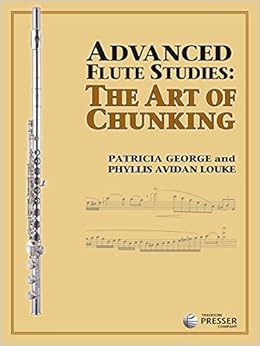
The Art of Chunking explores, well, the art of chunking.  Chunking is one method for learning music.  It is the idea of breaking large chunks of music down to smaller, more manageable portions.  In this book, the authors want students to focus on one group of sixteenths at a time, meaning one beat in most cases.  These beats are separated by a rest and this method, according to the authors, benefits the flutist in numerous ways including, but not limited to, eye coordination/short-term memory improvement, opening the throat during rests, and helping the flutist recognize patterns in the music.  In order to do this, the book contains a comprehensive daily warm-up, 48 lessons in major and minor keys, etudes, cadenzas, and solo works by Telemann, J.S. Bach, and C.P.E. Bach. This book is meant to follow the completion of Flute 103 or "any intermediate method." I do think students should at least dabble in this book because it presents many good concepts.  This book is somewhat on the honor system though because as any lesson teacher knows, we can't make our students practice the proper way.  We strive to teach and show them the importance and benefits in doing so, but in the end it is entirely up to the students themselves.

Excelsior!