Saturday, July 18, 2015

Flute 103: Have We Mastered the Basics Yet?

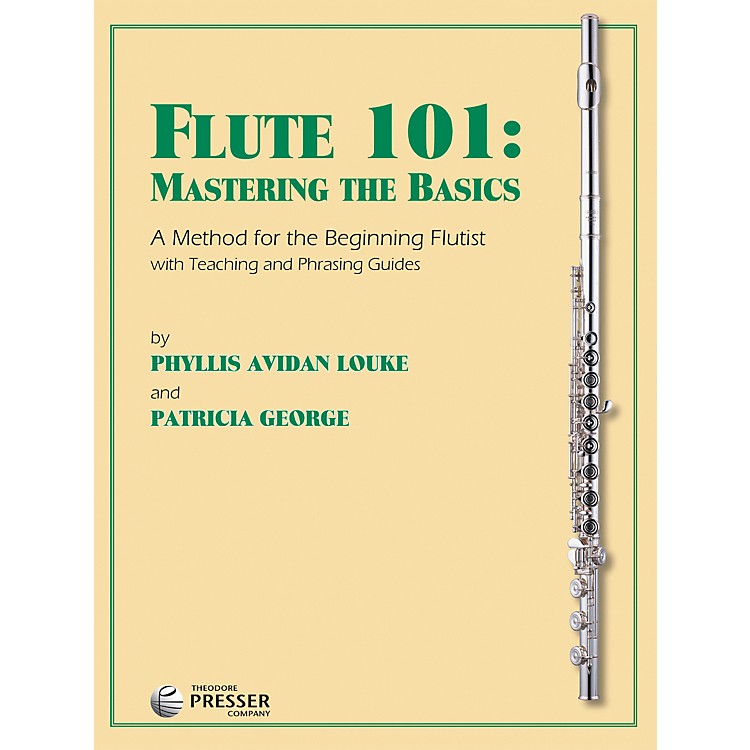
Here it is, the final installment of the Flute 101-103 trilogy!  And I thought I would throw in a couple of teasers at the end for The Scale Book and Advanced Flute Studies: The Art of Chunking because I've come this far, might as well.  I am so excited about the Flute 101 series and I hope that in the brief time I have spent on them I have given a good presentation of what they contain.  By no means do I think Flute Student should be shunned from society or lost to the flute civilization; I am the product of Flute Student and I think I turned out pretty great.  I merely get excited about the exploration of flute method because there is no one right answer.  Every student learns differently and for some of my students, Flute 101 will be more effective than Flute Student (or Suzuki - I feel like people might think I am attacking Flute Student :(  )

Highlights:
- continued structure of key signature themed chapters
- even more integration of standard repertoire
- use of extended techniques in each chapter to improve overall playing
- suggestion of working towards giving a solo recital, with sample programs
- more in-depth look at composers and their music, including performance guides

To give you an idea of what the performance guides are like, I will talk about the information that can be found in the guide for Gluck's Minuet and Dance of the Blessed Spirits.  First, this is an obvious choice to include because it is the definition of standard.  Like the Mozart, if you have dreams of becoming a professional flutist, you will play this at nearly every audition. And even if you don't have that dream, if you take private flute lesson, at some point your teacher will pull this gem out.

So what light is shed on the Minuet?  Here you are:
- A brief background on Christoph Willibald Ritter von Gluck
- A plot summary of the opera from which the Minuet comes, thank you(!)
- The musical context, what is going on in the orchestra during the solo
- A few basic reminders on the simpler aspects of playing musically (the piece is in 3/4 so strong-weak-weak)
- The musical structure, ABA, and how the sections differ
- Helpful cues/tips on how to play the written "grace notes"
- Many examples showing how subdivision in the B section is the key to rhythmic perfection
- Suggestions for musical gestures, i.e. sighs
- Concluding thoughts on the difficulty of the piece and the best ways to go about working on it (like, with a METRONOME)
- Once you get to the music, the A section includes the other flute part so that the teacher can play with the student; knowledge is knowledge is power

I think what I like about this series is that it makes it easier for students to do more investigative work on their own.  This is a basic all-in-one method.  That being said, I don't think that any flute student's education is complete with these books alone. No, no, no.  Everybody needs to experience some Andersen op. 33 action.  And they'll love it...I mean, we all did, right?  Just consider this a thrilling new venture in the world of flute pedagogy!

Now, as promised, here are quick looks into The Scale Book and The Art of Chunking!

The Scale Book: A Path to Artistry is a book meant for any level musician.  Seems like a good idea to me.  But how do you make scales "friendly" to a beginner?  Well, it helps that this book looks, physically, exactly like Flute 101.  Something that looks familiar is always less of a headache than something foreign.  The third page details how the authors think elementary, intermediate, and advanced students should tackle the book respectively.  Not only does this book introduce scales beyond major and minor, it makes references to musical examples like The Swan from "Carnival of the Animals" and the book correctly suggests that scales are the backbone of flute playing from technicality to tonality and musicianship. Here is what the authors say about why they made The Scale Book:

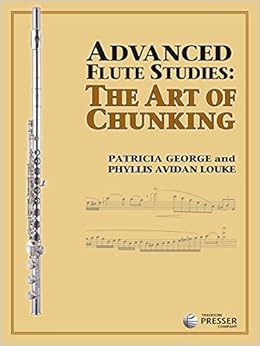
The Art of Chunking explores, well, the art of chunking.  Chunking is one method for learning music.  It is the idea of breaking large chunks of music down to smaller, more manageable portions.  In this book, the authors want students to focus on one group of sixteenths at a time, meaning one beat in most cases.  These beats are separated by a rest and this method, according to the authors, benefits the flutist in numerous ways including, but not limited to, eye coordination/short-term memory improvement, opening the throat during rests, and helping the flutist recognize patterns in the music.  In order to do this, the book contains a comprehensive daily warm-up, 48 lessons in major and minor keys, etudes, cadenzas, and solo works by Telemann, J.S. Bach, and C.P.E. Bach. This book is meant to follow the completion of Flute 103 or "any intermediate method." I do think students should at least dabble in this book because it presents many good concepts.  This book is somewhat on the honor system though because as any lesson teacher knows, we can't make our students practice the proper way.  We strive to teach and show them the importance and benefits in doing so, but in the end it is entirely up to the students themselves.

Excelsior!

Friday, July 10, 2015

Flute 102: A Flute Method Book that Acknowledges D7?! Insanity.

Welcome back to my gushing all over the flute method books by Patricia George and Phyllis Avidan Louke!  Today we briefly explore the features of Flute 102: Mastering the Basics.  If the blog posts I am doing on these method books pique your interest, I suggest you go to Amazon.com or Fluteworld.com to order these books.  They aren't that expensive, in fact I would go so far as to say they aren't expensive at all, and they are a great investment for your studio!


Let's jump right into my highlights of Flute 102:
- there are daily warm-ups
- there is a page dedicated to the circle of fifths
- the fingering chart goes from low B to high, high D
- lessons have been put into groups of five which comprise a chapter
- each chapter is titled something like, "F Major & Friends"
- there is a methodical but strong push on learning scales
- each chapter introduces standard solo repertoire (for example, in C Major & Friends, your students get their first look at Mozart's Andante in C!)
- there is a supplement at the end titled, "Contemporary Technique Solos" - yes, they introduce extended techniques!
- throughout the book, students are asked to focus on their tone, vibrato, and techniques like double tonguing

In short, this book continues where Flute 101 left off.  It promotes the practice and learning of essential musical concepts, like scales, while drawing attention to things that intermediate students will begin asking you about, like vibrato.  I am also thrilled that the chapters are done by key because it will give students the opportunity to briefly focus on key signatures which are still relatively "new" and difficult to remember.  I also think it is fantastic that students will be introduced to the standards of the flute repertoire.  A little Telemann, Mozart, Bizet, and Kuhlau never hurt anyone...much. :)  It should also be noted that with each standard piece comes a brief paragraph of music history.  This feels like a double win for me; it teaches the students about the composers and their music.  It gives them a better understanding of what they are working on.  Think about it, said no musician ever, "Eh, who cares about that dead guy and the world in which he was living; surely neither had any impact on his compositions."

But, not shockingly, what I think I am most excited about is the fact that extended techniques are introduced!  Students will begin to learn flutter tonguing, key clicks, harmonics, sing-play, microtones, timbral trills, pitch bends, and multiphonics through short pieces.  The pieces aren't too challenging and give a nice introduction to each technique.  Even better is the guarantee that the students will feel accomplished and think that the pieces sound cool.  That is a successful recipe for encouraging practicing!  Besides, it makes learning techniques seem more manageable.  There are so many great pieces out there now and most young students are listening to recordings wondering when they will be able to tackle Ian Clarke's "Great Train Race", for example.  Well, here is a great place to start!

Friday, July 3, 2015

Flute 101: The Obvious Title of a Flute Method Book

For most of my flute teaching career, I have used the Flute Student method book series.  However, at the suggestion (a very strong - one might say nagging - suggestion) of a fellow flute teacher, I ordered Phyllis Avidan Louke and Patricia George's "Flute 101: Mastering the Basics" book off Amazon.com.  Obviously, I have some thoughts to share because I am blogging about it, and here is the long and the short of it: I think it is utterly brilliant!

Here is a bullet point list of what I consider highlights of the Flute 101 method system:

- The first lesson - sort of a pre-lesson - is called "Fun with the headjoint"
- Lessons 1 and 2 teach G, A, B, and C
- Starting in lesson 3, if the fingering for low and high register notes are the same, you "learn" both notes
- Especially in the early lessons, many of the music selections are repeated in different registers and keys as the student learns more notes (in my experience, young students are more excited to practice and play music they already know)
- There are duets in nearly all, if not all, the lessons (I've never met a student who didn't think it was more fun to play with me and for more "social" students, this keeps the lesson interactive)
- Many of the lessons begin with warm-up suggestions (introduction of the importance of warming up? Be still my heart!)
- Constant bombardment of recognition of playing in a specific key (they do exist!)
- Extremely clear and repetitive introduction to rhythm
- Suggestions and tips throughout on how to play musically in a language easy for younger students to understand
- The book is spiral bound.  This is huge (meaning awesome - not a size reference)...believe me

Okay, okay, I seriously could go on and on and on...but I won't.  My plan for the remainder of the blog is to showcase in more detail one of my favorite aspects of the book.  Here we go!

So, the "pre-lesson" I spoke of:  "Fun with the headjoint" is an organized and accessible introduction to playing the flute with which all of us fine flute teachers are familiar.  The student focuses solely on producing a sound consistently with the headjoint alone.


They are simultaneously introduced to simple rhythms and counting.  Once they have mastered producing a sound, the authors introduce two songs, "Mary Had a Little Lamb" and "Hot Cross Buns", but having the student stick their index finger partially and fully into the end of the headjoint.


In part II of the pre-lesson, the students produce upper and lower register B's with their headjoint by placing their right hand over the end of the headjoint.

From here, there is more practice with ryhthms and playing both registers.  The pre-lesson closes with a teacher/student "Snake Charmer" duet in which the student plays upper and lower B's while the teacher plays the melody.  Super ingenious and super fun!


I highly recommend this book, especially for younglings!  The introduction to sound production, the repetition of songs, and the duets will keep any student excited and focused on learning the flute.  Blogs talking about Flute 102 and Flute 103 to follow! :)

Thursday, May 7, 2015

End of the [Academic] Year Hustle

The last few weeks have been very busy for me.  The Columbia Community Band had its last concert for the season and it was a lot of fun to play!  We played Elsa's Procession to the Cathedral by Wagner, The Whistler and His Dog which featured myself on piccolo and Dr. Manzo from the University of Missouri, and Sparke's Tuba Concerto (also with Dr. Manzo).  With the conclusion of that concert, CCB prepares for MU commencement ceremonies and our summer programs.  At last night's rehearsal, we read an arrangement of selections from The Wizard of Oz (see video)!  I was overjoyed to play it because it took me back to Jr. High as that piece was played often.  We also read my absolute favorite march, National Emblem.  The trio section is just amazing if you've got the low brass for it.  In short, it was a fantastic and fun rehearsal.

I also had a lot of fun making a flute lamp out of my aunt's old, run-down beginner flute.  My dad (and mom) came to visit a couple weekends ago and on a whim I decided it was time to turn that unplayable flute into something useful!  With my dad's help, it was surprisingly easy to make the flute into a lamp.  A flute is already hollow and the circumference works perfectly with the light bulb and lamp kit.  The most difficult aspect of constructing the lamp was finding a lamp base and then, once I found one, weighing the lamp down because the base was hollow and the flute is, of course, top heavy.  It was a fun project to do with my dad and every time I sit at my desk, I smile because it is just so awesome and beautiful.

The next big project I took up in order to make my life easier and better my studio was to create a catalog of my music library.  I have  A LOT of music.  Some might think I have a music buying problem, but really, I just like owning my own music and I can't help it if I find something called "Fun Flute Duets" while searching for something else.  What am I supposed to do?  Not buy a book of supposedly fun flute duets?!  And for the record, that book is, indeed, fun.  It has a lot of cool, and conveniently short, arrangements of duets in the following "categories": food, animals, traditional Irish, traditional American, and Halloween.  Anyway, back to the music library.  I started by creating an Excel file and putting in the title, composer, instrumentation, and group type (solo, duet, etc.) of each piece.  Then I went back in and gave each piece a letter (A,B,C, etc.) to represent various categories like "Flute Method" or "Flute Unaccompanied Solo" and then a number (1, 2, 3, duh...).  This might seem excessive, and maybe it is, but it will keep me sane and help me find music and keep track of music if I lend it out to a student or friend - yes, I created a "Checked Out"  column.  I am currently in the process of putting the ID (i.e. A-5) into a return address label template so I can print them out and place them on the proper pieces.  I also got 8.5x11 Alphabet Tabs at Staples (love Staples) to further my OCD organization system.  Super excited.

Leaving my nerdiness behind, I finally got around to planning and organizing the first annual Crecelius Flute Studio Recital!  My students will be sharing the stage with the students of Katie Smyth Flute Studio; this is Smyth Flute Studio's first recital as well.  I've got the programs printed, the venue secured, and my music in order.  It will be a wonderful afternoon of flute solos, duets, and a quartet.  It is my hope that this will be an annual tradition.  I remember playing in my Jr. High/High School flute and clarinet lesson teachers'  studio recitals growing up.  It was fun to have the opportunity to perform for my parents and I, as a music educator, believe it is important for my students to have the same opportunity.  Not only is it fun and makes parents happy because they get to hear their children play, but if my students continue to play music through high school or even go on to major in music, they will need to develop a stage presence and become accustomed to playing solos in front of people.  And obviously I hope that my students will, at least, play through high school.  I cannot wait for Saturday!

These are but a few things that have been happening in Crecelius Flute Studio - I love being busy.  In the near future, I hope to give a recital of my own.  It has been far too long since I gave a solo recital.  I have some pieces in mind, but I am definitely open to suggestions.  Sometimes, I think it is easier to just have someone tell me what to play.  Ah, the pains of not being in school anymore!  I also plan to be better about blogging again.  I would blame how busy I have been, but I really need to be more committed.  I have a few ideas for upcoming blogs and I hope to have exciting experiences this summer to inspire me!

Thursday, April 9, 2015

Learning New Music Challenge

This post is a challenge to any musician it reaches.  Here are the guidelines:

1.  Find a new piece of music to work on, a piece of which you have never played a single note.

2.  Before looking at this piece for the first time, assess your practice technique.

3.  Listen to the piece, score in front of you (if possible), regardless of whether you have never heard the piece before or you have heard it more times than you can count.

For all three of the above mentioned guidelines, your flute, or whatever instrument you play, should still be stowed safely in its case.  That's right.  Don't even touch the instrument.  Bad habits are far more easily attained than good ones.  The best way to fight off bad habits is not to touch your instrument until you've put some good thought into how to go about working on the piece.

So, now that I've brought up the elephant in the room, how do you practice?  Here, my good friend and fellow flutist, Katie Smyth, discusses one method.  And this lovely post is why I am here today writing the post I am writing.

What really stood out to me from the second link is the following:

1. The set-up: The students were given the music, a metronome, and a pencil.  A metronome and a pencil...

2.  The time of practice varied from 8.5 to 57 minutes.  Hmmm.

3. Some of the mentioned practice techniques from the top 8 practicers:
- "Practice was thoughtful, as evidenced by silent pauses while looking at the music, singing/humming, making notes on the page, or expressing verbal “ah-ha”s."
- "Errors were preempted by stopping in anticipation of mistakes. Errors were addressed immediately when they appeared."
- "The precise location and source of each error was identified accurately, rehearsed, and corrected."
and finally...
- "The number of times they played it correctly in practice...had no bearing on their ranking...What did matter was home many times they played it incorrectly. The more times they played it incorrectly, the worse their ranking..."

You really should read the whole post, it is quite good,but here are my takeaways.  Practicing doesn't have to be an all day nightmare affair.  If you are smart, you can get a lot accomplished in, say, 8 and a half minutes.  Studying the music before you play it is important.  It not only gives you the bigger picture, as in where your part fits in with everything else, but it also can help you identify the tricky parts you will probably spend most of your practice time working through.  You really shouldn't, at any point, just run through the piece over and over and over again.  Most likely, that will lead you to many bad habits.

Instead, isolate problem areas before they occur.  Discover what sort of technical issue you experience: fingerings, tonguing, vibrato/tone quality, breathing (if you are a wind instrument in particular), or dynamic.  Here are practice tips I know I have given before, but let me do it again because as a mother and a teacher I will spend my entire life repeating the same things over and over and over again.

1. Have a pencil with you.  Mark in anything that you need to, including accidentals.  If you missed the note more than once, just mark it in.

2. Practice with a metronome.  Practice way under tempo.  If you can play it perfectly slowly, you have an infinitely higher chance of playing it at tempo perfectly.  Slow practice is everything.

3. If you are having a fingering issue that slow practice doesn't cure, use rhythms (remember from practicing scales for district and state?  I'll post it again.), loops, anything that takes the measure or even one beat out of context so that you can clean up and finesse the part.

4.  Only practice one given problem at a time and for a maximum of 10 minutes at a time (or even a day).  Let's pretend that you have five problem areas.  Now think about it. If each problem area was isolated and received 10 minutes of intensive care, you'd get a lot of work done in under an hour.  An hour! Not 4 or 5 hours of making the same mistakes as you repeatedly do meager run-throughs of the piece.

5. If you are having an air support, or tone clarity problem, get rid of the vibrato in the practice room.

6. Need to work on double or triple tonguing?  Then do that.  Don't continue to hammer away at a passage your tonguing isn't ready for.  Single, double, and triple tongue scales during your warm up.  Flip the double or triple tonguing to engage the back half of the technique ( KTKTKTKT instead of TKTKTKTK).  Ever play a scale with just the back half (KKKKK)?  It's miserable, but it makes you better.

7. Listen to the music!  Honestly, it might be better to spend more time listening to someone play it correctly than you spend playing it yourself.  Also consider listening to, not just the piece you are working on, but other pieces by the same composer and works of other composers from the same period.  This will deepen your understanding of the composer's composition technique and it will make you aware of the proper playing styles/practices.

Learning how to practice well, efficiently, and successfully can take years to master, but once it's done, the results speak for themselves.

Back to my challenge, care to try it?  Want to take it further?  I had an amazing musician, conductor, and educator once suggest that I listen to and study a score for at least three months before I played a single note.  To this day, I haven't been able to wait that long.  But I'll do it if you do it with me.  What do you say?  Come on, jump in the pool with me!  It will be fun, and you'll be the better for it.

Wednesday, April 1, 2015

Performing in the Community: Singing with Full Heart and Voice

I am currently discussing the idea of putting together a sacred music performance at my parish.  Ideally, this is something that would grow into a more regular occurrence, perhaps with more musicians (not counting the congregation) participating over time.  It could create a choir that performs for and with the congregation, playing music they know but don't hear often and teaching them new music that could be incorporated into regular services.  Either way, it is a bonding experience with the members of my church that I really want to happen.

As I attempt to put together a program to present to the church music director, I am trying to balance well-known pieces with new pieces.  I am trying to create a theme of sorts.  I am trying to make the program fun, filled with songs that the audience will want to sing along to and will continue humming long after the performance ends.

This could be tricky though because every parish has its own musical identity.  I know that Queen of the Rosary in fair Elk Grove Village, IL had its own identity solidified in the foundation created by a musical director that had been there for years.  There were songs you anticipated hearing regularly and he had a set list for holiday masses.  The same goes for Sacred Heart in Notre Dame, IN.  Not shockingly, their identity had a strong Irish lilt to it.  The Celtic Alleluia was a standard and with the presence of fantastic in-house sacred music composers, the parish was set in its musical ways.

In both of my previous parishes, there were certain aspects of sacred musical practice that stick with me today.  QR makes me desperately wish there were a guitarist playing with me and then ND's choir came equipped with not only a guitarist, but a flutist, two violins, a cello, and a percussionist.  Of course, I can't expect Sacred Heart here in Columbia, MO to morph into either of the previously mentioned parishes.  I wouldn't want that either.  But I would be lying if I didn't say there were some itches I'd like to scratch that involve some more instrumentalists!  And from my experience, give the right percussionist the right percussion instrument and the music takes on a whole new life and, generally, the congregation seems to enjoy the addition.

As I progress in the planning and realization of this idea, I will keep you posted and, obviously, invite you!  Two things I know for sure:  It will begin with "All Are Welcome" and close with "May the Road Rise to Meet You" because really, could you do it any other way? :)

Thursday, March 19, 2015

An Email From Robert Dick


This morning, I woke up to find an email from professional flutist Robert Dick in my inbox.  It was his response to the "Do Not Read" segment on Monday night.  (begins around 2:18):


He wants to go on The Tonight Show starring Jimmy Fallon and I think it is a great idea!  How awesome would it be for him to pull a Lou Malnati's/Daily Show and prove how awesome he is at playing flute?  If it happens, I would expect (and hope) that Robert Dick would not even mention or go into the tasteless joke - that would only put the focus on the joke.  Instead, go on, talk about what you do, laugh and have fun, and play the flute in a way most people are completely ignorant.  But that's just my humble opinion. Here is his email with instructions on how you can help him play "The Other Flute"  on the show!

"Robert Dick Newsletter – March 19, 2015
This is an appeal for YOUR HELP to respond to a horrible sketch on the TONIGHT SHOW mocking me, my name and my book “The Other Flute”.
On Monday, March 16, Jimmy Fallon, host of the TONIGHT SHOW, the most watched TV show in the United States did an infantile “Dick joke” sketch about me and “The Other Flute”. 
Here’s the link so you can see this for yourself.
Do Not Read – THE OTHER FLUTE
 After taking counsel with a wide range of friends -- I have decided that a lawsuit is pointless. Bad taste isn't against the law, and Jimmy Fallon was within the bounds of protected free speech. He was certainly way out of the realm of good taste or respect to fellow humans. Very many of you have suggested that I go on the Tonight Show and I'm giving it my best shot. I NEED YOUR HELP. Go to the Tonight Show website, or the Tonight Show FaceBook page or to their YouTube page --and tell them that they just have to have me on and that I'll play the flute in a way that really is "The Other Flute" -- and in a funny and entertaining way -- will blow their minds. Here are the links:
You tube: https://www.youtube.com/watch?v=bG1Q2SkpttI   start at 2:20
Tonight Show website: www.nbc.com/contact/generalgo to "I have feedback", then "I have a comment or suggestion"
PLEASE WRITE YOUR MESSAGE TODAY AND SPREAD THIS FAR AND WIDE -- THE TONIGHT SHOW NEEDS TO RECEIVE THOUSANDS OF COMMENTS AND REQUESTS.
THANK YOU SO VERY MUCH.

Robert"

What do you think? Is this an appropriate response and should Robert Dick go on The Tonight Show? If you think he should, let The Tonight Show know!